
2. How the project was set up - leadership and understanding
Updated: Mar 18

By Dr Mike Florence
This project was of major strategic importance for the organisation and was a scientific first for the
disease therapy. I introduced the Balanced Capabilities rationale here. But to continue - as with all projects, getting the objectives, scope, expectations correct was essential. It helped having great scientists, science and leaders; Leaders that knew how to deliver great science through great project management.
Firstly, we held meetings with the sponsors and leaders to gain a first-hand understanding of their expectations and needs. This led to a draft ‘project brief’.
The expectation was very clear: to have a fully integrated, all functions, key CRO’s, CDMO’s as
MS project schedule that will show the critical path in enough detail to make confident and
prompt decisions.
With this information I could then refine the project brief and draft a charter and start conversations with the agreed team member. Especially clinical ops manager who had excellent experience, MS knowledge and communication skills.

A key part of the planning design was MS project
(not used by the organisation at this time) and that the structure had to be based on the Table of Contents (ToC) which is a standardized document structure, of 5 modules, that organizes and guides reviewers through the
information in a regulatory submission, such as a medical device or pharmaceutical application. The ToC structure really helped with consistency across the functions, provided a focus for the functions and allowed for ease of navigation and checking for interdependencies. As well as facilitating e-submission to regulatory authorities.
However, this ToC based schedule had never been done before in the organisation so there was
no reference or learning from previous projects. The team would need to build from scratch.
Building the Operations Team
The Operations team is the ‘engine room’ that drives the project forward. The team, with representatives of all the functions is a space for all the functional representatives to communicate, share and review the project status, any issues, risks and next steps.
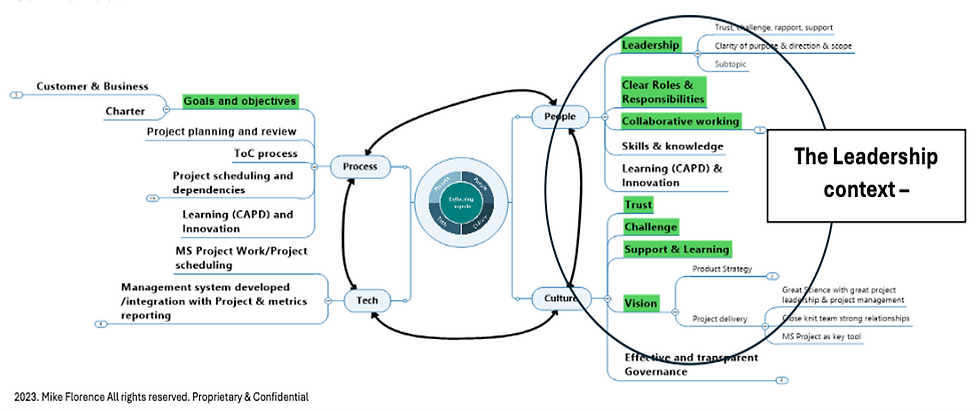
As introduced with the graphic in the previous article (see below), we built a good ‘leadership environment’ for Operations team through 1:1’s to share expectations, roles, needs, as well as the charter and functional / cross functional deliverables.
This project had some of the best functional team members I have worked with: Expert in their
field, open communication, clear thinking, and trusted completely. We, individually, shared
expectations for the project, our roles and built some ‘principles’ for our work together.
Based on Table of Contents (ToC) as closely as possible
Ownership by the team and functions
Must be of use for the users.
Clear accountability at each level
Planning and control meetings in place to get interactive and cross functional review,
update and discussions.
Supporting tools – risk check, assumption check, decision & changes
Trust each other – always open communication, chat through links, ideas
Visual planning and interactive ‘team room’ – chat adds value! Logistics
With the leadership context set up with the Steering team and the Operations team together
with the project charter and roles, it was time to use the processes and tech. to build the
structure of the project schedule. This was achieved using a visual and collaborative approach.
The next article will show how we got the project schedule foundation structures correct and
reflecting the sponsors’ expectations and needs.
Dr Mike Florence PhD, MBA
Coaching, Project Heath Checks, Improvements


Comments