
1. Building a successful team with Balanced Capabilities (and great people)
Updated: Feb 16

By Dr Mike Florence
My role in this team as a Global Project Manager/Leader (contract for 3 months) was to build an
operations team with a full Microsoft (MS) project schedule plan with risk management that would support the steering team and functional teams' decision making and so delivery. The Client was clear that a detailed fully integrated MS Project schedule (all functions & main CRO’s) must be created with the functionality to see the critical path and be used to make fast and correct decisions.
This series of articles is not intended to exemplify all the project management steps (these are given in many PM manuals) but rather a practical approach through engaging people and structuring their thoughts and information through visualisation (mind mapping). The multiple communication
lines to/from suppliers and CRO’s were professionally managed through the responsible function. The visual approach described in these articles, can be used for any subject from planning a holiday through to the example given below from pharmaceuticals.
To help facilitate high performing team working, I used an approach that balanced built the team's capability with a balance across the People Processes, Technology (Tech.) and Culture.

This is about creating balanced capabilities. These capabilities are highly related and interconnected such that addressing issues will require managing two, three or all of these areas to regain a sustained balance.
If you just focus on one of these capabilities, such as bringing in new IT (e.g. Tech. such as MS project) without managing the other capabilities then the balance will be lost leading to the investment and benefits not being fully realised. A tool can be a liability unless owned by teams and used correctly. Similarly, processes and peoples’ roles grow organically through the best intentions and result in a hugely muddled mix of inconsistent ways of working.
The Leadership Environment
The success of a project management structure is highly dependent on the leadership. The
feeling of trust, challenge, support and how the project team’s output is used by governance to
make decisions will make the difference on whether a team will thrive or not.
The highlighted (in green) points made this project’s environment challenging but supported by the Leadership.
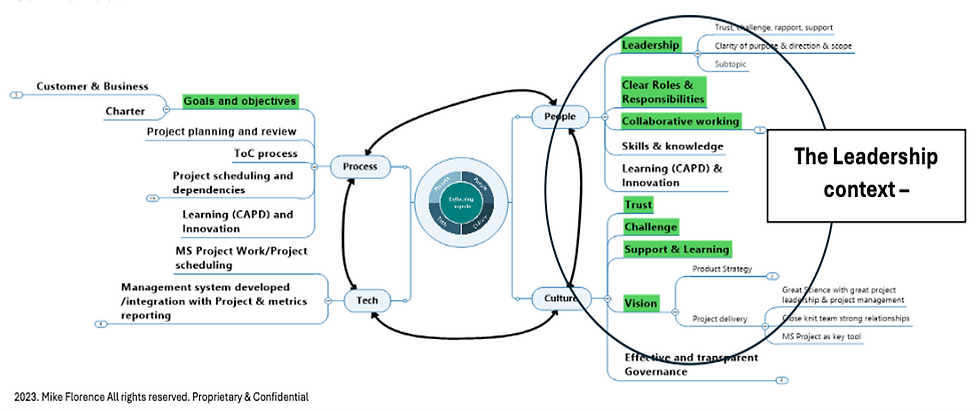
The Leadership Context explained ...
Culture & People: The culture of the team was really close with strong relationships developed
over the early phase development. Communication was open across the team; challenge was
natural, and all members were respected and trusted. There was great science but also an
expectation and need for great project management. This created the environment for my role
and made my job a lot easier.
Leadership (People) & Process: The Target Product Profile (TPP), Integrated Product Plan,
Clinical, Regulatory and market strategy and tactics, strategic threats, opportunities were
thoroughly understood and the ambition for a great product that could make a difference for
patients was well set out with clear decision points.
This Leadership context (Right hand side of map - People & Culture) provided the foundation to build the Processes and Tech (Left hand side of map) that would be used by the team.
Without this supporting Leadership context life would have been much harder for the project teams.
Look out for the next article - coming soon - which will show how we built on this Leadership Context (People and Culture) to get the Project Set Up and operational. Again, using a collaborative and visual approach to get the best involvement and so a project owned by the team.
Dr Mike Florence PhD, MBA
Coaching, Project Heath Checks, Improvements


Comments